

From decorative arts to total work
 6ᵗʰ and 14ᵗʰ arrondissements
🇬🇧 This journey has been automatically translated from its original french version. The translation may be inaccurate.
In the first half of the 20ᵗʰ century, the boundary between minor and major arts blurred. French creators combine their talents to produce total works, mixing architecture, design, graphic arts and crafts, in the service of a new, resolutely modern art of living. With this visit, we will leave from the 6ᵗʰ to the 14ᵗʰ arrondissements, discovering the lines and motifs of Art Nouveau style architecture and their evolution towards Modern Decorative Art.

Want to discover the journey ?
For total immersion, download our app and start the journey now!




Journey preview
Henri Sauvage's stepped building
 © CAUE de Paris - T. Ménivard
Less than 15 years after having created the villa of the cabinetmaker Louis Majorelle in Nancy, a true manifesto of Art Nouveau, Henri Sauvage joins forces here with Charles Sarazin to create this famous stepped house , inaugurated in 1912.
The tiered building
The particularity of this building is its facade on the street, the levels of which are set back from each other. This principle in tiers is only applied by the architects from the second floor, in order to respect the alignment with the street. This innovative construction system was patented by Sauvage and Sarazin in 1912-1913, so this is its first application. The constructive structure is part of a hygienist logic, thanks to the cascading withdrawals, each floor benefits from better sunlight, natural ventilation and a terrace.
 Building in 1917 © Charles Lansiaux / DHAAP
Fully tiled architecture
Don’t these beveled white tiles remind you of anything? These are those of Hippolyte Boulenger, who at the time held part of the market for those who covered the walls of Parisian metros. Punctuated with dots and dashes in blue tiles, this full ceramic covering is completely innovative, it is a first on a street facade in Paris. In addition to being an aesthetic marker (influenced by the Viennese architect Otto Wagner), these tiles are an asset for the sustainability and maintenance of the building.
 © CAUE de Paris - T. Ménivard
From the sports tiered house to the tiered building
Originally, the architects' intention was to create a building offering numerous common spaces: games and sports rooms, a greenhouse... The building permit for the sports tiered house was refused . Sauvage and Sarazin had to design a second, then a third building project in order to respect the town planning rules in force. These design developments canceled the sporting purpose of the building. Henri Sauvage will have the opportunity on rue des Amiraux (Paris 18ᵉ) to continue this reflection on programmatic diversity, with his swimming pool building.
In 1919, Henri Sauvage set up his architectural studio in the central void of the volume on rue Vavin, thus making this building a true demonstrator of his work.
Henri Sauvage's stepped building
© CAUE de Paris - T. Ménivard
Less than 15 years after having created the villa of the cabinetmaker Louis Majorelle in Nancy, a true manifesto of Art Nouveau, Henri Sauvage joins forces here with Charles Sarazin to create this famous stepped house , inaugurated in 1912.
The tiered building
The particularity of this building is its facade on the street, the levels of which are set back from each other. This principle in tiers is only applied by the architects from the second floor, in order to respect the alignment with the street. This innovative construction system was patented by Sauvage and Sarazin in 1912-1913, so this is its first application. The constructive structure is part of a hygienist logic, thanks to the cascading withdrawals, each floor benefits from better sunlight, natural ventilation and a terrace.
Building in 1917 © Charles Lansiaux / DHAAP
Fully tiled architecture
Don’t these beveled white tiles remind you of anything? These are those of Hippolyte Boulenger, who at the time held part of the market for those who covered the walls of Parisian metros. Punctuated with dots and dashes in blue tiles, this full ceramic covering is completely innovative, it is a first on a street facade in Paris. In addition to being an aesthetic marker (influenced by the Viennese architect Otto Wagner), these tiles are an asset for the sustainability and maintenance of the building.
© CAUE de Paris - T. Ménivard
From the sports tiered house to the tiered building
Originally, the architects' intention was to create a building offering numerous common spaces: games and sports rooms, a greenhouse... The building permit for the sports tiered house was refused . Sauvage and Sarazin had to design a second, then a third building project in order to respect the town planning rules in force. These design developments canceled the sporting purpose of the building. Henri Sauvage will have the opportunity on rue des Amiraux (Paris 18ᵉ) to continue this reflection on programmatic diversity, with his swimming pool building.
In 1919, Henri Sauvage set up his architectural studio in the central void of the volume on rue Vavin, thus making this building a true demonstrator of his work.
Studio-Apartments Hotel by Henry Astruc
 © CAUE de Paris - T. Ménivard
Studio-Apartments Hotel
This building was built in 1926 by the architect Henry Astruc, for an American investor wishing to accommodate a wealthy American clientele of artists in the Montparnasse district. It bears witness to an atypical program for the time which wishes to combine for its users: hotel comfort and domestic intimacy. This hotel therefore brings together, on its narrow and deep plot, around twenty workshop apartments offering a double-height main room with mezzanine. The building extends along the length of the plot with a building wing shaped like three sawtooths.
 © CAUE de Paris - T. Ménivard
The Decorative Art style
The street facade is made up of a two-bay frame. Quite sober in appearance, you have to take the time to observe the details:
- the framing which underlines and highlights the body of the building (from the first to the third floor),
- the large panels of frosted and engraved glass with art deco curtain patterns,
- the protruding balcony of the crowning with its glass paving stones,
- the wrought iron railings and door.
 © CAUE de Paris - T. Ménivard
The overall volume and architectural style bear witness to the beginnings of modern architecture in Paris. The facade, roof and stained glass windows were designed by Francis Jourdain, painter and designer, pioneer of the modern movement and founder of modern decorative arts.
Inside, the studios were furnished and decorated with lighting by Francis Jourdain.
Studio Raspail building by Bruno Elkouken
 © CAUE de Paris
This building, both an artist's studio building and a performance hall, was built in 1932 by Bruno Elkouken, an architect of Polish origin. The “Raspail 216” theater and cinema hall, at the heart of the long plot, was inaugurated in September 1934. The cinema then named “Studio Raspail” welcomed the public until 1982.
The modern movement
The architectural style of this building is fully in the modern movement. The façade on the boulevard, made of Burgundy stone slabs, is punctuated by two bays of rectangular bow windows which indicate the presence of the duplex artists' studios. The large glass roofs are characterized by the geometric graphics of their metal joinery.
 The ground floor in 1933 © Source gallica.bnf.fr / BnF
The symmetrical composition of the facade places the canopy marking the elegant entrance to the cinema in the center.
Artist workshops by André Arfvidson
 © CAUE de Paris - T. Ménivard
Accommodate the artists
In 1911, André-Louis Arfvidson built a building between rue Campagne-Première and Passage d'Enfer for Charles-Henry Bréal. This brings together artists' studios on four levels, in the heart of Montparnasse. This example, awarded in the city of Paris facade competition the same year, will become a model of this type of program:
- wide and high glass roofs facing north, allowing constant lighting of the workshops,
- double-height interior spaces for workshops,
- workshop associated with an apartment, here in duplex.
In this building, the sculptors worked on the ground floor and the painters on the upper floors.
A facade with abundant decor
Essential for the implementation of large bays, bow windows at the ends and double heights, the reinforced concrete structure is entirely covered with flamed sandstone ceramics by Alexandre Bigot.
 Details of the architectural ceramic © CAUE de Paris
With an aesthetic in transition, between floral Art Nouveau and more geometric Decorative Art, the profusion of ornaments presents a spectacular "signature building" for both the architect and the ceramist. Even today, the flamed sandstones in shades of ocher and brown offer great vibrancy of color.
The layout (implementation drawing) of the ceramics highlights the symmetrical composition of the facade. The sandstone elements are in turn flat, beveled, molded, in pellets, in pyramids or even in sculpted relief. Take the time to observe the profusion of simple modular elements and sculpted motifs (faces, flowers, or friezes), particularly the door frames.
 Facade on the Passage d’Enfer © CAUE de Paris
Returning to the boulevard, take a look at the passage d'Enfer, on the left just after n°245. With any luck, the gate will be open and you will be able to appreciate the back facade of the building.
Artist workshops by Charles Abella
 © CAUE de Paris - T. Ménivard
Modern architecture
This building, which brings together apartments and artists' studios, was built in 1930 by Charles Abella. Its architectural style reflects great modernity both in its volumes and in the sobriety of its covering. This one in sandy blond washed gravel is an alternative for the time, between the Parisian stone of the neo-classics and the radicality of raw concrete.
 Journal La Construction Moderne, 1931 © gallica.bnf.fr / BnF
From the street, you can clearly see the volumes:
- a cantilevered bow window at the corner testifies through its large openings to the presence of workshops,
- the loggias visible from the street set back the rooms of the accommodation,
- a rounded column whose vertical glazed elements and oblique moldings mark the presence of a stairwell.
 Plan, Journal La Construction Moderne, 1931 © gallica.bnf.fr / BnF
In the depths of the plot, we can see from the gate a large bow window with three double-height glazed sections.
 © CAUE de Paris - T. Ménivard
On the ground floor, the bas-relief frieze was created by Xavier Haas, painter and engraver, who had his workshop in this building. It represents the arts:
- from the street the sculpture, painting and writing are visible,
- inside the island music and harmony are represented.
Three studio houses by Louis Süe
 © CAUE de Paris - T . Menivard
Nos. 3bis, 5 and 7 of the street are the first works of Paul Huillard and Louis Süe, an important figure in art deco in France. They were made between 1903 and 1906. Based on an identical distribution model, these adjoining “houses-workshops” use varied materials and styles, witnessing a taste at the beginning of the century for eclecticism. and the decor, at a pivotal moment between classicism and rationalism. The three houses have the same distribution of interior spaces, with an artist's studio in the brightest location on the top floor.
 © CAUE de Paris
The first house-workshop built at No. 7 Rue Cassini was created for the painter Pol de Czernichowshi. A pastiche of the Louis XV style, it is made of cut stone topped with a large classic pediment. Its facade presents a certain freedom in the sculpted ornate decorations and above all, the asymmetry of its windows.
 © CAUE de Paris
At No. 5, the second is intended for the official history painter Jean-Paul Laurens. Its reinforced concrete structure is covered with bricks. Their dark red color gives the house the air of a 15th century residence, straight out of a Florentine or Flemish guidebook. We can observe an experimentation in the rhythm of the openings and a variety of their scale corresponding to their use: living room on the ground floor, bedroom and bathroom upstairs, then large projecting bay of the workshop of the building.
 © CAUE de Paris
The last one, at n°3bis, was built for the painter Lucien Simon. The oblique brick filling is very unique and the large vertical casement windows punctuate the facade. This time, the reinforced concrete structure allows a dominant ratio of glazing on this facade and the creation of a bow window for the upstairs bedroom.
François Saulnier’s residential building
 © CAUE de Paris - T. Ménivard
The architect François Saulnier, associated with the sculptor André Vermave created this residential building in 1903. It is made up of two bays, one of which has a curved bow window and overlooked by an artist's studio that can be recognized by the bay windows. The cut stone facade is decorated with low relief sculptures. They represent a woman holding a wreath of flowers, a lute player and a bird's nest in a left corner.
Robert Mallet-Stevens' Investment Building
 © The architect 1930
Art Deco collective building
At the bottom of the garden of this building hides the unique collective building created by the architect Robert Mallet-Stevens. Built between 1928 and 1929, this building offers a very beautiful illustration of the Art Deco architecture of the 1930s, combining modernity and tradition, constructive technicality and *artisanal know-how *.
For its creation, the architect surrounded himself with the skills of illustrious creators: the master glassmaker Louis Barillet, the architect and designer Jean Prouvé, the lighting designer André Salomon. .. The building on the street and the building on the garden have been listed in the supplementary inventory of historic monuments since 1984 and the building on the garden has been classified as historic monuments since 2021.
 © CAUE de Paris
A staged discovery
From rue Méchain, signs point to the presence of the modern construction hidden at the back of the plot. With two oculus housing stained glass windows by Louis Barillet, the concrete canopy and the heavy door by Jean Prouvé, the architect stages his discovery, offering it a real facade on the street.
Entering the hall, you discover the common areas with mahogany-clad walls, the dressing room which continues the rounded wall, the stairwell lit by three strips of Barillet stained glass and the metal banister with clean lines.
 © CAUE de Paris
It is by passing through the second door of Jean Prouvé that we discover, from the garden, the building built by Robert Mallet-Stevens. It consists of twelve apartments and two duplex workshops, one of which was occupied by the painter Tamara de Lempicka. Of unequal size and height, the two wings are articulated around a central “tower”, which accommodates the entrance and the stairwell and whose verticality is accentuated by a spectacular stained glass window again by Louis Barillet .
 © David Merry
Formalism and details
The design of the facades and the volumes of the building reflect with finesse and precision the traditional architectural vocabulary of the architect: corner windows, large horizontal bays, play of volumes, ratio of solids and voids, roof terraces, etc. The rigor of this formalism is combated by the details: metal railings of the balconies and terraces, flower boxes taken from the masonry which accentuate the play of horizontal lines, stained glass window of the staircase, large glass roofs on two levels, rounded porch and canopy above the entrance.
 © David Merry
The building constitutes an unprecedented order. It is no longer a question of designing a private hotel or a villa, but a collective housing building. The architect thus pays particular attention to these modern constructive characteristics and the high level of service offered to future occupants: central heating, hot water supply, two elevators, bathrooms equipped with built-in bathtubs, walls lined with earthenware for the water features, garbage disposal by incineration, sliding windows, terraces converted into gardens.
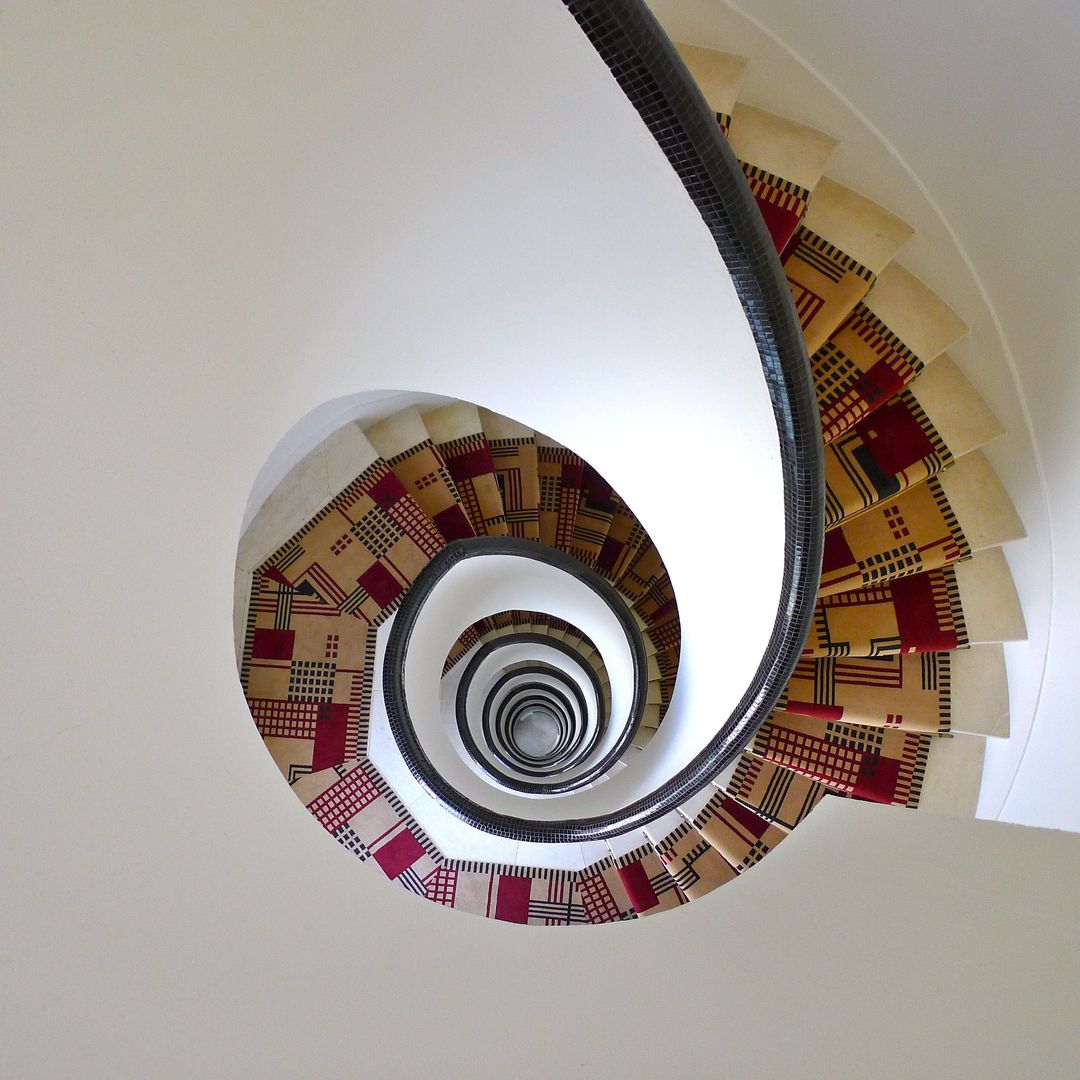
The helical staircase reaches up to the eighth floor. The black Briare enamel handrail highlights the serpentine created by the banister. The wool carpet, designed by Mallet-Stevens, takes up the geometric patterns of the stained glass window in the spirit of the De Stijl movement. Mahogany doors serve the apartments and the elevator.
 © CAUE de Paris
The building, intended for a bourgeois population, demonstrates through its spatial organization a very traditional vision of the distribution of social classes. A service staircase located in the rear part of the building serves the back door of each apartment. Located on the eighth floor terrace, the service rooms are only accessible from this staircase. The architect even went so far as to design a tunnel which connects the building on the street to the service stairwell, so that the servants do not use the garden paths.
The Alden Brooks House by Paul Nelson
 © CAUE de Paris - T. Ménivard
This stage offers a short detour into the 13ᵗʰ arrondissement to discover the Alden Brooks house.
This is contemporary with Robert Mallet-Stevens' building since it was built in 1928 by the architect Paul Nelson. This architect of American origin trained in the workshops of Auguste Perret and graduated in 1927. This house, which takes up the principles of the master, is therefore the first work created by the architect and commissioned by one of his compatriots, the writer Alden Brooks.
Modern expression of the facade
Paul Nelson designs a house that expresses "the truth" of materials and structure. The visible skeleton is made of bush hammered concrete and the filling is made of bricks. The non-load bearing character of this filling is all the more asserted as it frees itself from any symmetry in the location of the windows. These bays are not exclusively vertical, but sometimes horizontal or square, foreshadowing certain constructions from the 1950s.
 © CAUE of Paris - T. Ménivard
At first glance, this facade may appear stripped of ornament, but when you get closer, the checkerboard layout of the bricks appears. It presents a design composed of groups of four thin bricks matched lengthwise. The hollow and thick joints give relief to this wall.
The crown of this house is marked by the concrete bands forming the spandrels of the continuous balconies.
Private house of Paul Follot
 Urban landscape in 1918 © Charles Lansiaux / DHAAP
The French cabinetmaker and decorator Paul Follot built this mansion for himself in 1911. The building, witness to this period of transition from Art Nouveau to Decorative Arts, brings together its apartments, an artist's studio and an art gallery.
It is important to take a step back to appreciate its formal curiosity. Its domed roof with a semi-circular hipped roof and its oval bays are inspired by northern architecture.
 © CAUE de Paris - T. Ménivard
The ground floor is finely decorated with a geometric mosaic, gold, black and white, whose aesthetic is reminiscent of the paintings of Gustav Klimt. This marquetry is part of the exposed concrete facade, scratched in a checkerboard pattern or smooth and curved in the base. This elegant decor is completed by ironwork elements signed by Edgar Brandt (ironworker notably of the doors of the Palais de la Porte Dorée).
Today, the ground floor is occupied by the Institut Giacometti which undertook, in 2018, the conservation restoration of the mansion with the architect Pierre-Antoine Gatier. All of Paul Follot's original decor has been restored (entrance vestibule, living room and dining room) or preserved. It is possible to take a guided historical and architectural tour by the Institute.
Léon Boucher’s investment building
 Corner of the street in 1918 © Charles Lansiaux / DHAAP
Built in 1911 by Léon Boucher, this building occupies a privileged position at the corner of rue Boulard and rue Froidevaux, opposite the Montparnasse cemetery.
This curious building oscillates between Art Nouveau and Art Deco. It is of particular interest since it well illustrates the transition period between the two styles. It features rounded balconies, symmetrical double windows and ceramic flower garlands along the facade. Having not signed, the ornamentists will remain anonymous.
 Door entrance inlaid with mosaics © CAUE de Paris
Georges Grimberg’s artists’ homes and studios
 Flowered facade © CAUE de Paris - T. Ménivard
This building was built according to the plans of the architect Georges Grimberg in 1929.
In the 1920s, architects refused cut stone facades, which were too classic and expensive, and the appearance of concrete was still too avant-garde. They find hygienic and ornamental qualities in tiling. The building is covered with small multicolored ceramic elements creating a delicate geometric and floral marquetry. These details contrast with the monumental proportions of the building.
 © CAUE de Paris - T. Ménivard
Without even entering the building, the mix of interior occupations can be guessed. The readability of the middle bay is achieved thanks to the large bay windows intended for the artists and the two more traditional side parts for the accommodation. This facade composition allows the building to mark the bend of the street and to fit into its landscape with a more conventional rhythm close to the adjoining walls.
Residential building and artist studios of Émile Molinié
 © CAUE de Paris
The building was built in 1913 by the architect Emile Molinié and won an award the same year in the city of Paris facade competition.
The facade is characterized by its two bow windows and its large bay windows illuminating the workshops. On the fourth level, a frieze of yellow ivy leaves on a brown background is made by Eugène Ledoux, using the wall decoration process known as sgraffito. Several layers of coating are superimposed and before they dry, ornaments and sculptures are scraped off. This technique, being economical at the time, did not resist the rain and faded on the facade which was not sheltered by a cornice.
 Details of the frieze of yellow foliage on a brown background © CAUE de Paris
Note on the ground floor the wrought iron entrance door and the colorful and geometric band which marks the base.
 © CAUE de Paris
Annex of the town hall of Georges Sébille
 © CAUE de Paris - T. Ménivard
The last stage of this route invites you to discover more monumental architecture.
Built by Georges Sébille and inaugurated in 1936, the 14th century town hall annex is an example of the Modern decorative art style. This building still contrasts today with the surrounding post-Haussmann buildings by its size, its materials and its architectural style.
Through its massive volume, its very symmetrical composition and its large balcony on Square Ferdinand-Brunot, the building fully expresses public power. The town hall annex initially housed an ambitious program: meeting or party rooms, library, dispensary, district court, etc.
 © CAUE de Paris - T. Ménivard
As is often the case in interwar architecture, the secondary work constitutes the only exterior decoration whose forms are inspired by the geometric repertoire of the period. The annex offers monumental gates in artistic ironwork on both streets, forged by Raymond Subes for the main door and Gilbert Poillerat for the side one. The sobriety of the facade highlights the antique bas-reliefs executed on either side of the central body by the sculptor Raymond Delamarre. Furthermore, a large glass composition by Louis Barillet overlooks the bay which leads to the large balcony.
 © CAUE de Paris - T. Ménivard
It is built on a reinforced concrete frame covered with red bricks, the use of which at this time tends to become widespread for public constructions.
Side activities

Access the journey
 Vélib'
Bréa - Raspail (station no. 6007)
 Metro
Metro
Notre-Dame-des-Champs (line 12)
Vavin (line 4)
 Bus
Bus
Notre-Dame-des-Champs (lines 68, 82 or 58)
Vavin (line 68)