

Behind the scenes at Paris City Hall
 4ᵗʰ arrondissement

🇬🇧 This journey has been automatically translated from its original french version. The translation may be inaccurate.
The CAUE of Paris offers you a virtual tour of the Town Hall to discover its history and its decorations!
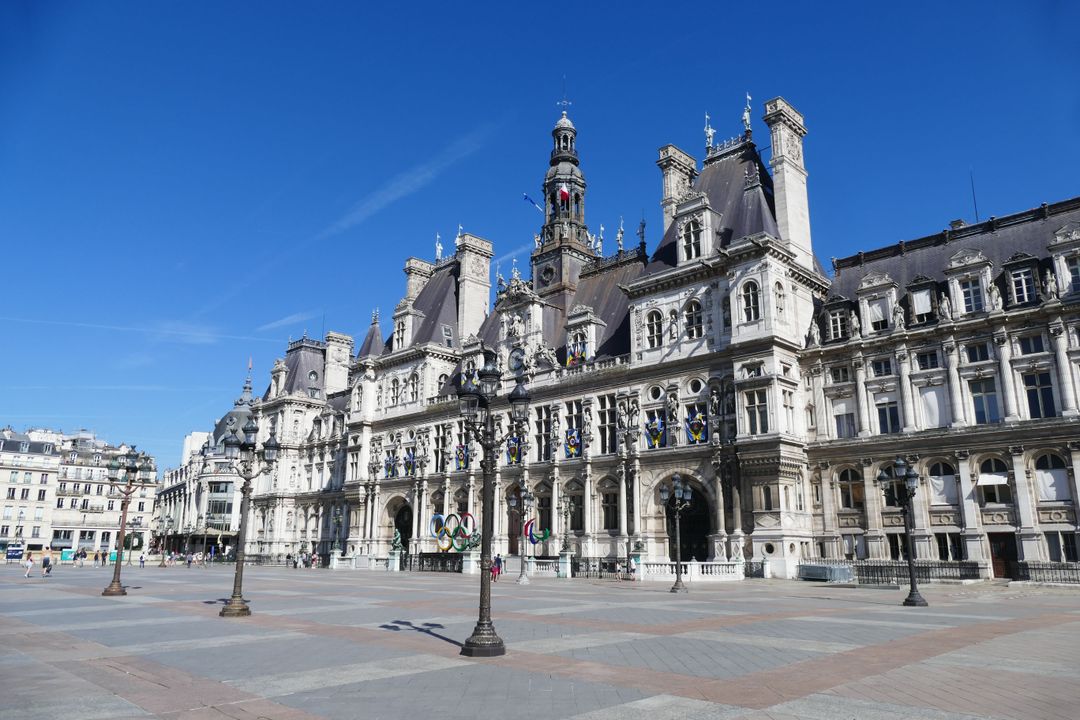
The Town Hall is a representation of the neo-Renaissance style. It was initially built by the architects Théodore Ballu and Édouard Deperthes in 1357. Since that date, the Paris City Hall has never left its location but it has undergone numerous transformations over the centuries. The building was successively burned, destroyed, rebuilt, enlarged, to become the Town Hall that we know today.

Want to discover the journey ?
For total immersion, download our app and start the journey now!




Journey preview
Escaliers d'Honneur
 © CAUE de Paris
The aesthetic and shape of the Honorary Staircase were inspired by the work of architect Jean-François Chalgrin, who built the impressive staircase of the Luxembourg Palace at the beginning of the 20ᵗʰ century.
 © CAUE de Paris
Opposite the steps, you can admire an equestrian statue made by the animal sculptor Emmanuel Frémiet. “Le porte-falot”, a bronze statue dating from 1883, represents a character on horseback carrying a lantern. It is one of many monumental works commissioned directly by the State.
 © Hôtel de Ville de Paris: escaliers d'honneurs - Pierre Lampué, 1882. Ville de Paris/BHVP
The wall decorations of the main staircase leading to the Mayor's office are the work of the painter Pierre Puvis de Chavannes.
 © Escaliers d'honneur (Hôtel de Ville) - G. et F. Girardin, 1870. Ville de Paris/BHVP
The statues and ornamentation around the main staircase celebrate the values of the Town Hall: justice and public assistance.
 © Ville de Paris/BHVP
Each head of state welcomed at City Hall treads the steps of this staircase.
More content

Escaliers d'Honneur
© CAUE de Paris
The aesthetic and shape of the Honorary Staircase were inspired by the work of architect Jean-François Chalgrin, who built the impressive staircase of the Luxembourg Palace at the beginning of the 20ᵗʰ century.
© CAUE de Paris
Opposite the steps, you can admire an equestrian statue made by the animal sculptor Emmanuel Frémiet. “Le porte-falot”, a bronze statue dating from 1883, represents a character on horseback carrying a lantern. It is one of many monumental works commissioned directly by the State.
© Hôtel de Ville de Paris: escaliers d'honneurs - Pierre Lampué, 1882. Ville de Paris/BHVP
The wall decorations of the main staircase leading to the Mayor's office are the work of the painter Pierre Puvis de Chavannes.
© Escaliers d'honneur (Hôtel de Ville) - G. et F. Girardin, 1870. Ville de Paris/BHVP
The statues and ornamentation around the main staircase celebrate the values of the Town Hall: justice and public assistance.
© Ville de Paris/BHVP
Each head of state welcomed at City Hall treads the steps of this staircase.
More content
Salon des Arcades
 © Ville de Paris - Sophie Robichon
The Salon des Arcades was previously called “Salon du Préfet”. It is today divided into three parts dedicated to three different themes: arts, literature and sciences. These rooms all served as places for meetings, exchanges and official discussions. For example, the signing of the marriage contract of Miss Valentine Haussmann, daughter of Baron Haussmann, took place in the Salon des Arts.
 © Croquis de M.C.Y., 1865. Ville de Paris/BHVP
The Salon des Arts was so named because of its particular use. In the late 20th century, landscape paintings, once considered a minor art, began to decorate the walls of official buildings, such as those of the city hall. This show was a place of renewal for certain artists .
The Salon des Sciences, for its part, is dedicated to the innovations that appeared at the Town Hall, such as the installation of telephone and electricity, at a time when all buildings were lit by gas.
 © Ville de Paris/BHVP
More content
Salon Jean-Paul Laurens
 © Ville de Paris
The salon takes its name from the history painter Jean-Paul Laurens. Dedicated to the history of Paris, it is decorated with six monumental paintings which retrace six centuries of history, the subjects of which were taken from The History of France by Jules Michelet. We can see the signing of the first franchise charter by Louis VI or the massacres of the day of riots of February 22, 1358, linked to the new taxes.
The city coat of arms is represented in a window, accompanied by the medals awarded to the City of Paris (Légion d'Honneur 1900, Croix de Guerre 1919 and Croix de la Libération 1945).
 © CAUE de Paris
The large window also displays parchments signed by French and foreign heads of state during official receptions at the Town Hall.
More content
Salon Georges Bertrand
 © Ville de Paris - Sophie Robichon
 © CAUE de Paris
The paintings in this living room were created by the painter George Bertrand. It pays tribute to rural France of the 19th century, by representing scenes of life in the countryside and work in the fields and fishing.
 © Fiorillo and Neurdein brothers, 1870-1890. Ville de Paris/BHVP
This specific theme of glorification of the Earth was chosen because this living room was formerly the large dining room of the Prefect.
This is where all the official meals were held with heads of state welcomed at City Hall like President Roosevelt on April 19, 1910. The menu below will give you an idea of what the government elites ate.
 © Ville de Paris / BHVP
More content
Salle des Fêtes
 © Ville de Paris
The large function room is the centerpiece of the state rooms of the Paris City Hall, it is richly decorated: mirrors, crystal chandeliers, gilding... Renaissance architecture is inspired by the architecture of Antiquity which uses three forms of ornamentation in capitals (upper part) of the columns:
- Doric order
- ionic order
- Corinthian order, as here.
 © Ville de Paris/BHVP
 © Ville de Paris/BHVP
This place was not only used for receptions and balls. It was also a meeting place for politicians during voting periods. In 1869, the village hall was, for example, used for counting subscription letters.
 © Ville de Paris/BHVP
More content
Town Hall Library
 © Ville de Paris
The library was completely destroyed in 1871 in the fire of the old Town Hall. It was rebuilt from 1872 and finally opened its doors on June 15, 1890. It is a central documentation service of the Paris City Hall, as well as a conservation and research library open to the public: the library has 600,000 printed volumes, thousands of handwritten pieces, architectural drawings and photographs.
 © City of Paris/BHVP
It is particularly rich in the fields of science and history of Parisian and national administration, law, economics, social life, political life, town planning and contemporary history.
 © Ville de Paris/BHVP
A reading room was built in 1885 by the architect Édouard Deperthes, inspired by the Sainte-Geneviève library. Its architecture earned it the status of historical monument.
More content
Salle du Conseil
 © Ville de Paris
The Council Room is located on the site occupied by the Throne Room in the old Town Hall. This room is a place of important power, more than 160 Paris councilors meet there about ten times a year.
 © CAUE de Paris
In 1935, the seating arrangement, previously perpendicular to the windows, was changed to create a hemicycle. As in the National Assembly, places are allocated according to political group.
 © Ville de Paris/BHVP
The sessions are public and broadcast live on the City of Paris website. Three stands are always reserved for the public and the press.
 © Ville de Paris/BHVP
More content
Mayor's Office
 © Henri Garat/Ville de Paris
The Mayor's office was previously the office of the prefects of the Seine.
It is the largest office in the Republic with its 155 m², larger than that of the President of the Republic and the Prime Minister.
 © Henri Garat/Ville de Paris
Former PS mayor Bertrand Delanoë had numerous contemporary art works installed in this room. In 2010, many of the works exhibited were acquired by the Municipal Contemporary Art Fund (FMAC), some of which had been loaned by the artists themselves. Today, the Mayor's office is still considered a showcase of contemporary art.
 © Henri Garat/Ville de Paris
More content
Parvis de l'Hôtel de Ville
 © Ville de Paris
The origin of the town hall dates back to the Middle Ages. In 1357, Étienne Marcel, provost of the merchants of Paris, purchased the “Maison des Piliers”, located on the Place de la Grève (current Place de l’Hôtel de Ville) to establish the Parisian municipality there.
 © Léon et Lévy, 1890, South-east pavilion on the quay. Ville de Paris/BHVP
This falling into ruin at the beginning of the 16th century, a new palace was built in its place by the Italian architect Boccador, in a style which combines Italian Renaissance and French classicism.
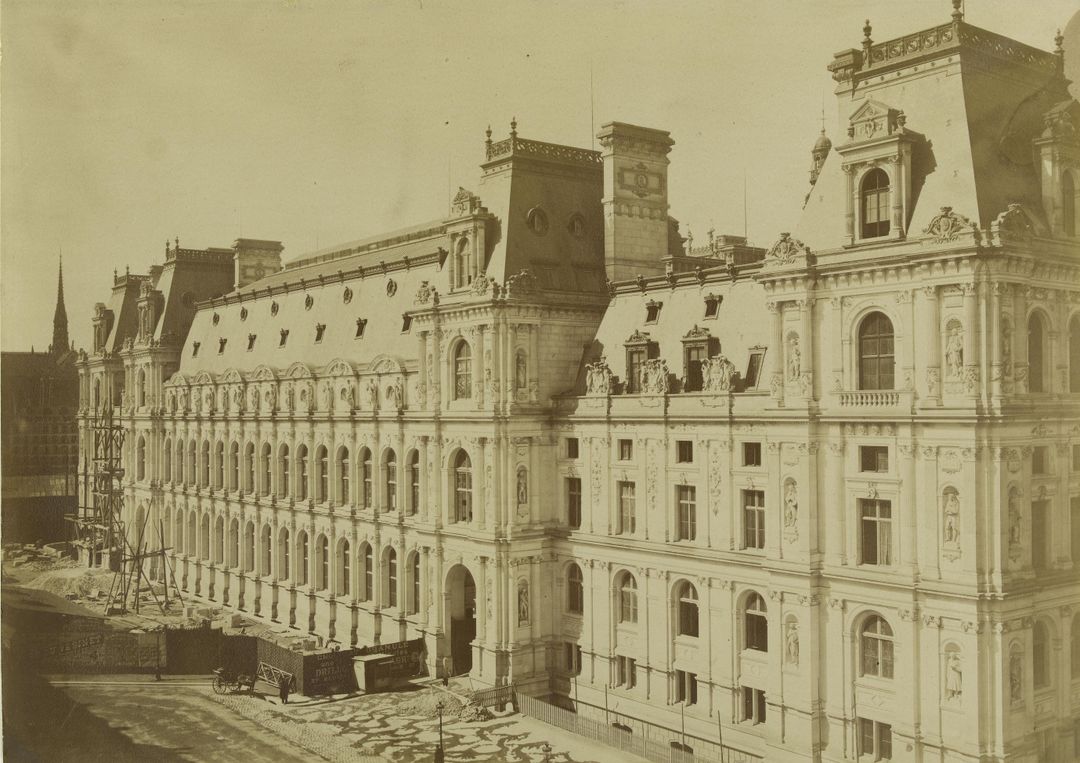
 © Albert Fernique, 1882, Reconstruction of the Town Hall facade on rue Lobau. Ville de Paris/BHVP
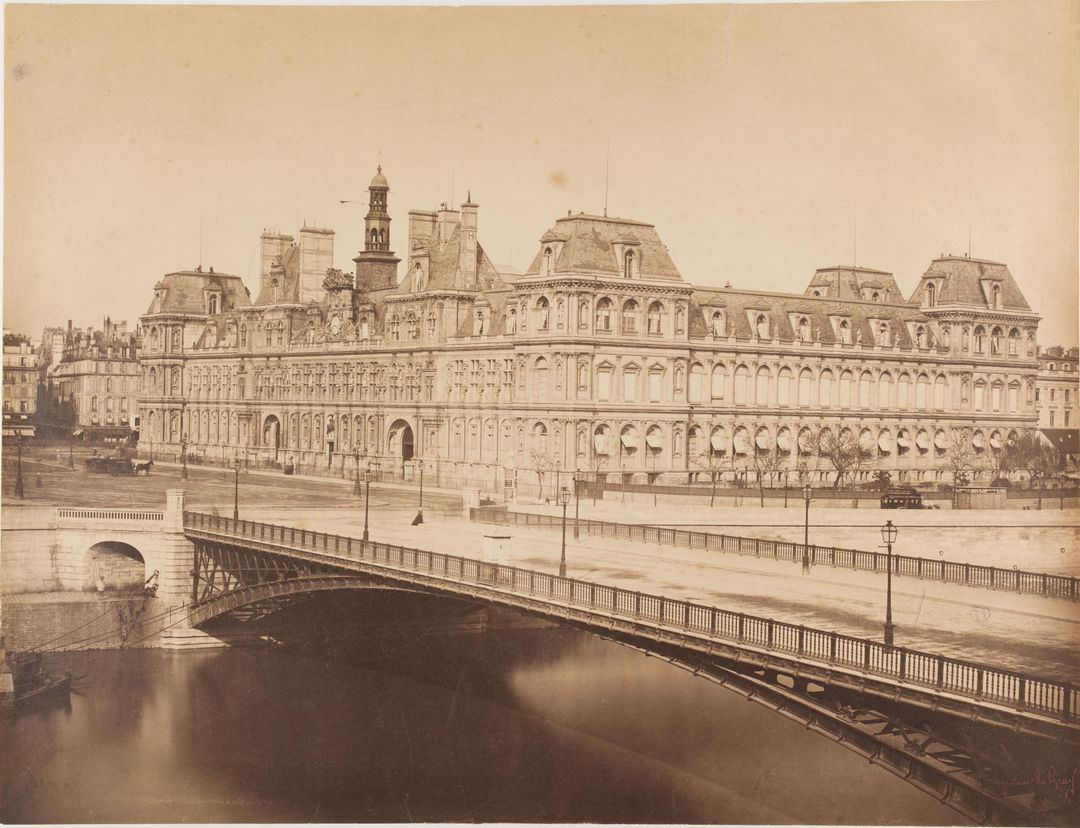
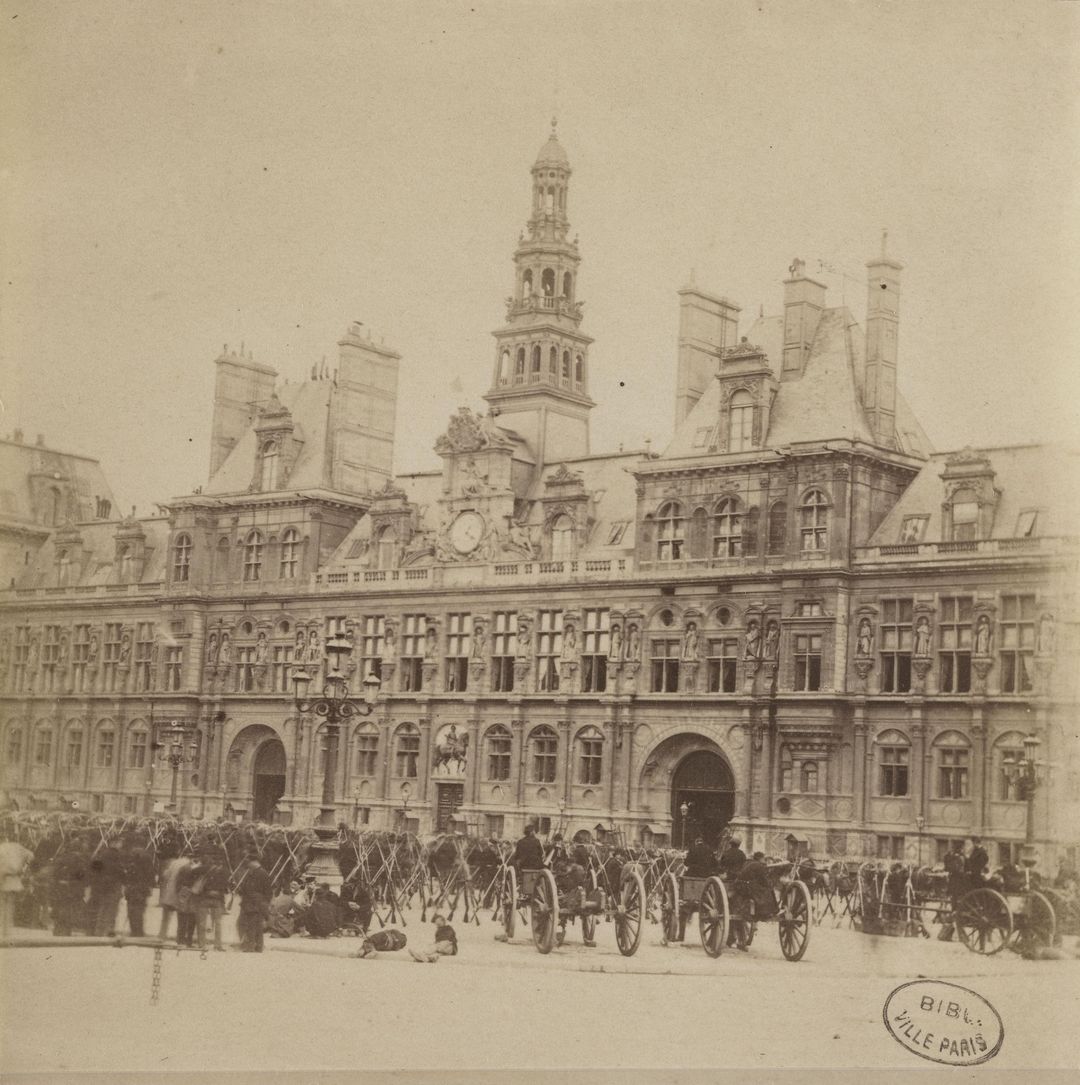
During the 18th century, the Town Hall was expanded several times, accompanying the evolution of the capital and its growing administrative needs. In 1871, it was destroyed by a fire and the municipal council decided to rebuild it identically. However, the interior of the building was modified to adapt it to its new administrative functions.
 © Albert Mansuy, 1860-1871, The old Town Hall and part of the Arcole bridge. Ville de Paris/BHVP
Since 1357, the Paris City Hall has never left its original location, but the building has undergone numerous transformations over the centuries. Renaissance architecture is characterized by great regularity and a search for symmetry.
 © Charles Lansiaux, November 15, 1919, Electoral poster boards behind the Town Hall. Ville de Paris/BHVP
The crowd used to gather on the square, to attend parties, the Midsummer bonfires or to wait for job offers. Workers looking for work used to gather in the square to pass the time while waiting to be hired. This is also where the name of the square "place de la strike" comes from: being on strike meant being waiting for a job, but with changes in the language, the meaning has completely changed. Even if this place continues to host numerous gatherings today, it is not only in the context of protests (video) but also in the context of cultural events: exhibitions, sporting events, concerts, etc.
 © L'Hôtel de Ville et la place de Grève Nicolas Jean-Baptiste Raguenet, 1751 - Musée Carnavalet, Histoire de Paris
More content
Side activities

Access the journey
 Vélib'
Lobau - Hôtel de Ville (station no. 4016)
 Bus
Bus
Hôtel de Ville (lines 67, 69, 70, 72, 75, 76, 96)
 Metro
Metro
Hôtel de Ville (lines 1 and 11)